


 Posts
Posts


SQL Developer 2.1 early adopter is now available for download from OTN. Go to the main SQL Developer pages on OTN for more details and the links to the download site. The announcement includes links to a number of documents that you should skim through before you start.
An early adopter is your opportunity to take a look at a build and feedback your findings to the development team before the product is released as production software.
SQL Developer 2.1 includes lots of new bits of code, like the updated data grids. With these you'll be able to sort data based on drop lists and highlight records based on the data. To name just two of the many new features.
In addition to this the release includes a free Data Modeler Viewer. This extension to SQL Developer allows you to open any model created in the stand alone SQL Developer Data Modeler. You can also open the Data Model Viewer and then drag tables from the Connections navigator to the Relational model to create a model of your objects. These models can't be saved, but you can drag the tables around on the diagram to see how the relate to each other and to see the tables and foreign key constraints on a model.
Perhaps the most significant feature of all is the new PL/SQL Unit Testing Feature. Using this, you can build unit tests for your PL/SQL code stored in the database. The unit tests are saved in a unit test repository and can be rerun when needed. Ideally you can build up a suite of tests and rerun them when you code is changed to test and trap regressions. Walk through this Oracle By Example tutorial, available on OTN, to learn a little more about this new feature.
If you have any feedback on the new early adopter, then please use the SQL Developer forum on OTN.
29 September 2009


07 August 2009
SQL Developer Data Modeler: Working with Domains
I hope you found the little demo about creating update scripts with the Data Modeler useful. Do you ever work with Domains? If this is a familiar topic for you, then here is a quick demo to show you how to work with domains in the Data Modeler. It does not tell you about why you'd use domains in great detail. I'm really trying to keep these demos to under 6 minutes. When I do the demos for OTN, I think I might even cut this in two. Anyhow, there is a quick demo on Domains:
Please note I added "Numeric" for one of the domains I added and should have entered the Precision and Scale. In this example, the DDL will only generate NUMBER, not NUMBER(8).
Please note I added "Numeric" for one of the domains I added and should have entered the Precision and Scale. In this example, the DDL will only generate NUMBER, not NUMBER(8).
06 August 2009
Updating the Database Using Detail From your Data Model
One of the predominant questions that has come our of the forum is how to update the database with the changes you have made on your relational model in the Oracle SQL Developer Data Modeler. I have created this brief demonstration to illustrate what we have tried to explain on the forum.
If you roll your mouse over the screen of this demonstration you'll notice a icon to the bottom right-hand corner. This will allow you to watch the demo in full screen, which may be easier. The demo is 5mins 27.
If you roll your mouse over the screen of this demonstration you'll notice a icon to the bottom right-hand corner. This will allow you to watch the demo in full screen, which may be easier. The demo is 5mins 27.
04 August 2009
Listen to Customer feedback on the Data Modeler
Maggie Tompkins of the US Marine Corps, a long time member of ODTUG and well known advocate of Oracle Designer, has been speaking to Kimberly Billings, from Oracle, about her experiences with Oracle SQL Developer Data Modeler. Maggie talks about they felt about the new product and how they were able to move their data models from Designer to the Data Modeler.
The MP3 is available to listen to, from the www.oracle.com/podcasts pages, or directly from here.
The MP3 is available to listen to, from the www.oracle.com/podcasts pages, or directly from here.
31 July 2009
Data Modeler connects to the Database...(another online demonstration)
The last few demos I have done have been about creating models without the need for a database connection. In this next one you do need a connection to the database, as the demo is about connecting to and importing the detail from the data dictionary.
The demo talks about the diagram and the subviews created. It shows the logical model and details and then looks at the physical models that are created.
I do assume you have already created a connection and so if you're struggling with that, here's a screen shot of the connection dialog. Like SQL Developer, you can just make use of the thin JDBC driver to connect to the database, as I have in the example. You probably won't see the extra DB2 and SQL Server tabs I have, unless you've added the required drivers for those. If you want to connect to those databases, then you can add the drivers by using the Tools > General Options settings.
The dialog also supports connecting to your entries in the TNS file and you can add your own custom JDBC URL using the Advanced connection type.
Once you have your connection set up, watch the online demonstration to learn more about what you can import.
The demo talks about the diagram and the subviews created. It shows the logical model and details and then looks at the physical models that are created.
I do assume you have already created a connection and so if you're struggling with that, here's a screen shot of the connection dialog. Like SQL Developer, you can just make use of the thin
 JDBC driver to connect to the database, as I have in the example. You probably won't see the extra DB2 and SQL Server tabs I have, unless you've added the required drivers for those. If you want to connect to those databases, then you can add the drivers by using the Tools > General Options settings.
The dialog also supports connecting to your entries in the TNS file and you can add your own custom JDBC URL using the Advanced connection type.
Once you have your connection set up, watch the online demonstration to learn more about what you can import.
30 July 2009
The Data Modeler supports Partitions
So the snag with a new product is to try to show all the features in the product to everyone as quickly as possible. I'm working on the online demos and training internal teams and getting the message out in general, but it's not fast enough. I'm looking forward to the day when you all start blogging about the product. Until that happens I'm afraid we're going to be dipping and diving all over the place. Just wait until SQL Developer 2.1 comes out and this blog becomes a mix and match!
We've recently had the question asking when we'll start support for partitions. The answer is right now. The product already does.
You need to understand the difference between the relational table definition, and the physical definition.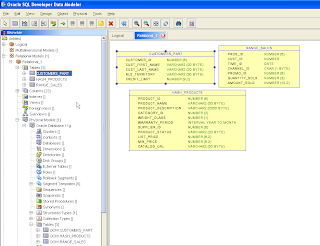
When you start creating the relational model, you create the tables that make up the diagram. The details are listed under tables under the relational node, as shown in this first image. (Click the image to see a full screen shot)
Invoking the properties here for the table, provides a database independent view of the table. So you can specify columns and datatypes and make use of domains at this point. What you can't do is specify the schema details or the other physical properties, like the tablespaces or partitions. This is because not all databases support the same set of physical properties.
The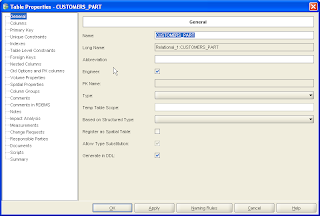 second screen shot shows the property dialog for the table in the relational model. Here you can add columns, set primary or foreign key properties, the datatypes and domains. There are entry point for indexes and a variety of additional features. But you do not set any database specific implementation details.
If you expand the physical model under the main relational model, (select Open from the context menu and select the database you want to support) and then expand the node. This is also shown in the first image above. Now you can view or add partitioning details.
Below are two illustrations, one showing the partition order in the Sales table, which is partitioned by range.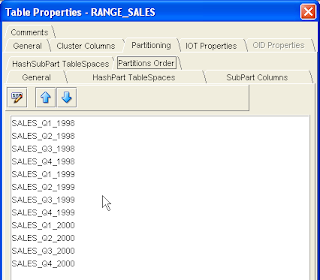
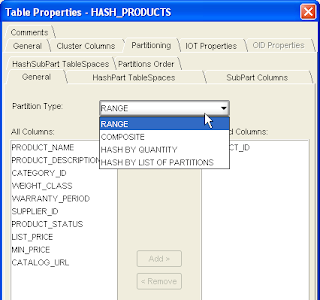
The last of the screen shots displays another partitioned table. The illustration here shows the drop list to show the types of partitioning supported.
The mantra is: The logical model is central, if you like is the core of the product. Each logical model supports one or more relational models. These visual models are database independent. Each relational model supports one or more physical models.
What the next demo to come out later this week, where we import for the data dictionary. That demonstration shows the multiple physical database support.
We've recently had the question asking when we'll start support for partitions. The answer is right now. The product already does.
You need to understand the difference between the relational table definition, and the physical definition.

When you start creating the relational model, you create the tables that make up the diagram. The details are listed under tables under the relational node, as shown in this first image. (Click the image to see a full screen shot)
Invoking the properties here for the table, provides a database independent view of the table. So you can specify columns and datatypes and make use of domains at this point. What you can't do is specify the schema details or the other physical properties, like the tablespaces or partitions. This is because not all databases support the same set of physical properties.
The
 second screen shot shows the property dialog for the table in the relational model. Here you can add columns, set primary or foreign key properties, the datatypes and domains. There are entry point for indexes and a variety of additional features. But you do not set any database specific implementation details.
If you expand the physical model under the main relational model, (select Open from the context menu and select the database you want to support) and then expand the node. This is also shown in the first image above. Now you can view or add partitioning details.
Below are two illustrations, one showing the partition order in the Sales table, which is partitioned by range.

The last of the screen shots displays another partitioned table. The illustration here shows the drop list to show the types of partitioning supported.

The mantra is: The logical model is central, if you like is the core of the product. Each logical model supports one or more relational models. These visual models are database independent. Each relational model supports one or more physical models.
What the next demo to come out later this week, where we import for the data dictionary. That demonstration shows the multiple physical database support.
29 July 2009
New Customer Article on OTN: Getting Started
So there are users articles and there are Oracle product manager articles... sometimes it's handy to get the perspective from someone outside Oracle. Here's one of those opportunities.
If you're just starting out with the Data Modeler, take a look at this latest article just published on OTN. Written by an Oracle DBA, it's a very brief review of how you can connect to an XE database and quickly create a data model using Oracle SQL Developer Data Modeler. His initial experience was with the early adopters and then the production release. It follows on nicely from the last two demos I talked about where you do not need to have a database to create the model. Here you do and is the next demo I'm working on.
If you're just starting out with the Data Modeler, take a look at this latest article just published on OTN. Written by an Oracle DBA, it's a very brief review of how you can connect to an XE database and quickly create a data model using Oracle SQL Developer Data Modeler. His initial experience was with the early adopters and then the production release. It follows on nicely from the last two demos I talked about where you do not need to have a database to create the model. Here you do and is the next demo I'm working on.
25 July 2009
Still no Database? Build a Data Model from a DDL script
In my last post I said that you can use the SQL Developer Data Modeler to build a data model without needing a database, all you need to do is start drawing. Well, you can also create a data model, without a database, but with a DDL script. The Data Modeler page on OTN has a number of the DDL scripts that you can use for this purpose. On OTN they're in zip files for easy download; all you need to do is extract the DDL file and then using the Data Modeler, import the DDL file.
This quick online demo shows you how you can import one DDL script to create an initial relational model and then use the Data Modeler to add the contents of a second file.
Next week we'll start work with a database, so if you haven't got access to one, now is the time to download and install Oracle Express Edition, to use as your sandbox. The next two demos I plan are to connect to the database and import a model and of course the one that follows has to be how to create those update scripts.
This quick online demo shows you how you can import one DDL script to create an initial relational model and then use the Data Modeler to add the contents of a second file.
Next week we'll start work with a database, so if you haven't got access to one, now is the time to download and install Oracle Express Edition, to use as your sandbox. The next two demos I plan are to connect to the database and import a model and of course the one that follows has to be how to create those update scripts.
24 July 2009
Data Modeler: Getting Started - You don't need a database!
If you are new to the latest tool from the SQL Developer team, then a short live demo might be just the thing you need. The great thing about the Data Modeler is that once you have downloaded and unzipped the product, you can just get going. No need for a database or a connection, just unzip and click the datamodeler.exe to start the product.
Now once the product is started, there is no need to create a project, you can start drawing. Click the tool bar button to create a table and you're off and creating.
Watch this 5 minute online demo to see a few extra tidbits of detail, such as controlling the naming of primary and foreign keys and a brief look at interacting with Design rules.
Now once the product is started, there is no need to create a project, you can start drawing. Click the tool bar button to create a table and you're off and creating.
Watch this 5 minute online demo to see a few extra tidbits of detail, such as controlling the naming of primary and foreign keys and a brief look at interacting with Design rules.
21 July 2009
Extensions to SQL Developer
I'm pleased to say that there are a few folk who are starting to write about their extensions to SQL Developer. I know there are people who are extending - indeed some customers are building quite extensive extensions , but not a lot of folk are telling us about their experiences.
John Flack recently did a talk about his experiences at the ODTUG conference in Monterey Bay and he has now posted his work. He talks about it on the ITToolbox site, and invites you to keep an eye on that as he plans to add more in time. He's posted the paper on his own site here. If you're building extensions to SQL Developer, or thinking about it, I'd encourage you to take a look, as John had some good examples in his talk and you might be able to pick up an extra tip or two. When I do the demo at events, I tend to add extensions for sub partitions or an extra node in the navigator for dimensions or similar. John has added a node for his instance data. This has the useful advantage that he can drill down through the instance data, using the navigator.
John Flack recently did a talk about his experiences at the ODTUG conference in Monterey Bay and he has now posted his work. He talks about it on the ITToolbox site, and invites you to keep an eye on that as he plans to add more in time. He's posted the paper on his own site here. If you're building extensions to SQL Developer, or thinking about it, I'd encourage you to take a look, as John had some good examples in his talk and you might be able to pick up an extra tip or two. When I do the demo at events, I tend to add extensions for sub partitions or an extra node in the navigator for dimensions or similar. John has added a node for his instance data. This has the useful advantage that he can drill down through the instance data, using the navigator.
15 July 2009
A Piece of SQL Developer News: 1.5.5
We released SQL Developer 1.5.5 on OTN yesterday.
You may be wondering why we have had so many minor releases of SQL Developer. The main release with all the new functionality is SQL Developer 1.5 and we published a list of the new functionality that went into 1.5. Following a main release we've typically had a significant patch release, which in this case was 1.5.1. The next three releases were minor and while they have each had a number of additional bug fixes, each had a specific role.
1.5.3 - our first Japanese translation
1.5.4 - we added the rest of the languages we'll be supporting Japanese, Spanish, Italian, German, French, Brazilian Portuguese, Simplified Chinese and Korean
1.5.5 - this is the release that is scheduled for 11gR2 and is also on the media pack with the new Oracle SQL Developer Data Modeler.
...and each pulled in a few issues that had raised their heads on the forum, along with few others. Methinks it pays to be involved and active on the forum.
The Data Modeler is drawing lots of interest, which is great news. We've just published a Pricing FAQ on OTN as there has been some confusion on that.
You may be wondering why we have had so many minor releases of SQL Developer. The main release with all the new functionality is SQL Developer 1.5 and we published a list of the new functionality that went into 1.5. Following a main release we've typically had a significant patch release, which in this case was 1.5.1. The next three releases were minor and while they have each had a number of additional bug fixes, each had a specific role.
1.5.3 - our first Japanese translation
1.5.4 - we added the rest of the languages we'll be supporting Japanese, Spanish, Italian, German, French, Brazilian Portuguese, Simplified Chinese and Korean
1.5.5 - this is the release that is scheduled for 11gR2 and is also on the media pack with the new Oracle SQL Developer Data Modeler.
...and each pulled in a few issues that had raised their heads on the forum, along with few others. Methinks it pays to be involved and active on the forum.
The Data Modeler is drawing lots of interest, which is great news. We've just published a Pricing FAQ on OTN as there has been some confusion on that.
02 July 2009
Oracle SQL Developer Data Modeler is Production
Well,well, well... it's July and in the UK the temperatures have reached the 30's. This might be normal for many of you, but for us, the gardens, the houses and the dogs are not quite used to it. Now for those of you thinking that this has become a biannual weather blog, you might not be far off. Since the last was in January and it was talk of snow...
So the reason for the lack of "blogginess" is multi-fold, some is that I have been working on our new product in addition to SQL Developer and some that I am writing a SQL Developer book. So it's not so much lack of material as lack of hours to write some more...
Now I do have so much to share with you, that I'm really keen to break this silence and get more words to paper (screen). Also there are many lovely little features in SQL Developer 1.5.4 that I find many of you don't know about, when I show them at events, that I should be doing short features more often. Mind you here's a blog on REAL-TIME SQL Monitoring, a feature that I wanted to write about for ages and Doug Burns has done it instead. (Thanks Doug) I've also been sent a list of blog topic suggestions from an attendee at one of the recent events I attended, so there really is no excuse.
Now that new tool: Oracle SQL Data Modeler. It's production! We published all the related material yesterday and hopefully the news won't be overwhelmed by all the Oracle Fusion Middleware 11g annoucements happening this week. Still it's all good and all good news.
You can download it from the main OTN site, as it's a featured download there, or you can go to our Data Modeler homepage for links to the download and the FAQ and other supporting technical docs and examples. This page will be updated fairly regularly as we add more bits of collateral. Remember too to use the SQL Developer forum if you have questions, and when I return from my blogging holiday, I'll mix SQL Developer and Data Modeler news and details here.
So the reason for the lack of "blogginess" is multi-fold, some is that I have been working on our new product in addition to SQL Developer and some that I am writing a SQL Developer book. So it's not so much lack of material as lack of hours to write some more...
Now I do have so much to share with you, that I'm really keen to break this silence and get more words to paper (screen). Also there are many lovely little features in SQL Developer 1.5.4 that I find many of you don't know about, when I show them at events, that I should be doing short features more often. Mind you here's a blog on REAL-TIME SQL Monitoring, a feature that I wanted to write about for ages and Doug Burns has done it instead. (Thanks Doug) I've also been sent a list of blog topic suggestions from an attendee at one of the recent events I attended, so there really is no excuse.
Now that new tool: Oracle SQL Data Modeler. It's production! We published all the related material yesterday and hopefully the news won't be overwhelmed by all the Oracle Fusion Middleware 11g annoucements happening this week. Still it's all good and all good news.
You can download it from the main OTN site, as it's a featured download there, or you can go to our Data Modeler homepage for links to the download and the FAQ and other supporting technical docs and examples. This page will be updated fairly regularly as we add more bits of collateral. Remember too to use the SQL Developer forum if you have questions, and when I return from my blogging holiday, I'll mix SQL Developer and Data Modeler news and details here.
09 January 2009
Frost on the Ground and New Year Ahead
Happy New Year to you all! May 2009 be a great year. I know our newspapers are full of gloom, but I'm looking forward to the year and some of the promise it holds.
2008 was quite a year for us in the SQL Developer team. I took a month off in March to work with children in a Delhi slum and then hit the ground running on my return as we were working on bringing a new product on board and the challenges that brings. After that I was back on the road talking at as many conferences and events as we could fit in. I'm really lucky in that our development managers, Kris and Barry, will travel and talk at these events too and so I'm not so stretched and SQl Developer gets to more events. I'm hoping to get more folk involved from other teams this year and so we can settle down to working on ensuring the features you request are in the product.
Conferences I talked at in 2008 were RMOUG, in Denver, ODTUG, in New Orleans, OOW, in San Francisco, SOUG, in Glasgow, Scotland, SAOUG, in Pilanesberg, South Africa, SOUG, in Switzerland, Oracle Develop, in China, UKOUG, in Birmingham, England, DOAG, in Nuremberg, Germany. While the list seems long, it is missing a few obvious spots! South America, Australia, New Zealand, Canada and great chunks of Europe and Asia. Perhaps if you live in an area where there is a user group and you know a bit about SQL Developer, you should consider doing a presentation. You'd be amazed how much you learn and how little things you show folk can be really useful.
Of all the talks I do, the one on creating user defined extensions is the most fun. There are always folk in the audience who suddenly have an idea and want to go home a try them. I'm hoping to see some of those ideas come to the fore this year. Let's hear about them. I'd also love to see your laundry list of places you talked at and what you presented (On SQL Developer of course)
Of course I should mention that we started to talk about SQL Developer Data Modeling and by the end of 2008 had released our second early adopter. We've had over 10,000 downloads of the beta software, so we're really excited that there is an interest and that many of your are testing and sending us feedback. Thank you! If you haven't tried it yet, try now. (That link takes you to OTN with viewlets and white papers and the link to the download.)
SQL Developer in 2008
We had planned to go from SQL Developer 1.2.1 to SQL Developer 2.0, but then the list of user requests on the SQL Developer Exchange was so long, that we decided on an interim release and so SQL Developer 1.5 was born. As ever we followed with a patch release to fix a few issues and so 1.5.1 was the main release of the year. SQL Developer 1.5.2 does exist, it's the release that is part of JDeveloper 11g, which was production soon after Oracle Open World in September. The next release planned was to address our translations and so SQL Developer 1.5.3 was purely a translation drop, but we soon realized that not all the languages were quite accurate and as Japanese was the most requested translation release, we were able to release our Japanese build, SQL Developer 1.5.3. So although 2008 was the year of 1.5.x, we will be slipping another 1.5.x drop into the start of 2009 with the other translations in the build. This'll mean that SQL Developer supports 9 languages.
Mountains in the Snow...
I ended my year of travel in the mountains in Scotland. If you're going to walk on frozen ground, then I recommend you do that there! Actually I ended the year climbing up though a temperature inversion. Not a big deal if you're an 'plane or climbing in the Alps, but a feat in Scotland. What a day! We walked up through the mist and then the clouds onto the top of the mountain and bright skies. The white on the rock is feathery ice, not snow.
SQL Developer Events in 2009
It's probably not going to be the "year of the conferences", but there are a few to add to your diaries now:
Oracle Develop: Moscow (4-5 Feb)
Oracle Develop: Prague (10 - 11 Feb)
RMOUG: Denver (10 - 12 Feb)
Collaborate: Orlando (3-7 May)
ODTUG: Monterey (22-25 June)
OOW is in October this year in San Francisco.
That should keep us going for a while.
With the exception of Collaborate, we'll have hands on sessions at all the events. For the above events, the speakers will be Barry, Kris and I. We'll also have a few Oracle Developer Days, which provide hands on sessions and will be run by local staff. Details for those will be on OTN.
SQL Developer in 2009
So the piece you're probably most interested in - what's up for 2009?
Well, our first release will be soon and that's the 1.5.4 release I mentioned above. We're dependent on getting all the translated files back, and then we can go, but it shouldn't be too many months.
Then we head for SQL Developer 2.0. This is our "modeling" release. I use the quotes, because we'll be releasing SQL Developer Data Modeling as a stand alone release - a purely data modeling product, so that those of you who don't want to do any SQL or PL/SQL coding can just model. (and those of you who don't want to model, will not have that included in SQL Developer.) So the plan is to release 2 products, SQL Developer 2.0 and SQL Developer Data Modeling, at the same time, later this year.
If you're not a Data Modeler, don't despair, SQL Developer 2.0 will be including a number of smaller requested features and many updates to the features that are already there.
Requesting New Features
Before I close, if you're still there, I'm seeing a number of features requested that are already in the product. This means that you're not finding the nuggets of wealth ;-) in the product. If you have features you love to use or find a few things that you struggled with and then solved, why not write it up? We have a blog we'd love you all to participate in: http://sqldevelopersig.blogspot.com/ It only has my first entry in it, and I'd love you all to add a piece. You just need to let me know and we can give you access.
Otherwise, I'm hoping, but not committing to, writing a few more little entries here, so that you can enjoy the benefits of the features the developers have added. (According to my decline in blog entries over the last few years, I only need to do 4 this year!)
Have a good one.
Sue
2008 was quite a year for us in the SQL Developer team. I took a month off in March to work with children in a Delhi slum and then hit the ground running on my return as we were working on bringing a new product on board and the challenges that brings. After that I was back on the road talking at as many conferences and events as we could fit in. I'm really lucky in that our development managers, Kris and Barry, will travel and talk at these events too and so I'm not so stretched and SQl Developer gets to more events. I'm hoping to get more folk involved from other teams this year and so we can settle down to working on ensuring the features you request are in the product.
Conferences I talked at in 2008 were RMOUG, in Denver, ODTUG, in New Orleans, OOW, in San Francisco, SOUG, in Glasgow, Scotland, SAOUG, in Pilanesberg, South Africa, SOUG, in Switzerland, Oracle Develop, in China, UKOUG, in Birmingham, England, DOAG, in Nuremberg, Germany. While the list seems long, it is missing a few obvious spots! South America, Australia, New Zealand, Canada and great chunks of Europe and Asia. Perhaps if you live in an area where there is a user group and you know a bit about SQL Developer, you should consider doing a presentation. You'd be amazed how much you learn and how little things you show folk can be really useful.
Of all the talks I do, the one on creating user defined extensions is the most fun. There are always folk in the audience who suddenly have an idea and want to go home a try them. I'm hoping to see some of those ideas come to the fore this year. Let's hear about them. I'd also love to see your laundry list of places you talked at and what you presented (On SQL Developer of course)
Of course I should mention that we started to talk about SQL Developer Data Modeling and by the end of 2008 had released our second early adopter. We've had over 10,000 downloads of the beta software, so we're really excited that there is an interest and that many of your are testing and sending us feedback. Thank you! If you haven't tried it yet, try now. (That link takes you to OTN with viewlets and white papers and the link to the download.)
SQL Developer in 2008
We had planned to go from SQL Developer 1.2.1 to SQL Developer 2.0, but then the list of user requests on the SQL Developer Exchange was so long, that we decided on an interim release and so SQL Developer 1.5 was born. As ever we followed with a patch release to fix a few issues and so 1.5.1 was the main release of the year. SQL Developer 1.5.2 does exist, it's the release that is part of JDeveloper 11g, which was production soon after Oracle Open World in September. The next release planned was to address our translations and so SQL Developer 1.5.3 was purely a translation drop, but we soon realized that not all the languages were quite accurate and as Japanese was the most requested translation release, we were able to release our Japanese build, SQL Developer 1.5.3. So although 2008 was the year of 1.5.x, we will be slipping another 1.5.x drop into the start of 2009 with the other translations in the build. This'll mean that SQL Developer supports 9 languages.
Mountains in the Snow...

I ended my year of travel in the mountains in Scotland. If you're going to walk on frozen ground, then I recommend you do that there! Actually I ended the year climbing up though a temperature inversion. Not a big deal if you're an 'plane or climbing in the Alps, but a feat in Scotland. What a day! We walked up through the mist and then the clouds onto the top of the mountain and bright skies. The white on the rock is feathery ice, not snow.
SQL Developer Events in 2009
It's probably not going to be the "year of the conferences", but there are a few to add to your diaries now:
Oracle Develop: Moscow (4-5 Feb)
Oracle Develop: Prague (10 - 11 Feb)
RMOUG: Denver (10 - 12 Feb)
Collaborate: Orlando (3-7 May)
ODTUG: Monterey (22-25 June)
OOW is in October this year in San Francisco.
That should keep us going for a while.
With the exception of Collaborate, we'll have hands on sessions at all the events. For the above events, the speakers will be Barry, Kris and I. We'll also have a few Oracle Developer Days, which provide hands on sessions and will be run by local staff. Details for those will be on OTN.
SQL Developer in 2009
So the piece you're probably most interested in - what's up for 2009?
Well, our first release will be soon and that's the 1.5.4 release I mentioned above. We're dependent on getting all the translated files back, and then we can go, but it shouldn't be too many months.
Then we head for SQL Developer 2.0. This is our "modeling" release. I use the quotes, because we'll be releasing SQL Developer Data Modeling as a stand alone release - a purely data modeling product, so that those of you who don't want to do any SQL or PL/SQL coding can just model. (and those of you who don't want to model, will not have that included in SQL Developer.) So the plan is to release 2 products, SQL Developer 2.0 and SQL Developer Data Modeling, at the same time, later this year.
If you're not a Data Modeler, don't despair, SQL Developer 2.0 will be including a number of smaller requested features and many updates to the features that are already there.
Requesting New Features
Before I close, if you're still there, I'm seeing a number of features requested that are already in the product. This means that you're not finding the nuggets of wealth ;-) in the product. If you have features you love to use or find a few things that you struggled with and then solved, why not write it up? We have a blog we'd love you all to participate in: http://sqldevelopersig.blogspot.com/ It only has my first entry in it, and I'd love you all to add a piece. You just need to let me know and we can give you access.
Otherwise, I'm hoping, but not committing to, writing a few more little entries here, so that you can enjoy the benefits of the features the developers have added. (According to my decline in blog entries over the last few years, I only need to do 4 this year!)
Have a good one.
Sue
10 October 2008
First Early Adopter: Oracle SQL Developer Data Modeling.
I've just put this announcement onto OTN:
The SQL Developer team is pleased to announce their first Early Adopter release of Oracle SQL Developer Data Modeling.
- Review the main data modeling page, with links to initial documentation and supporting collateral.
- Access the Early Adopter Download. This download link walks you through a brief one-time survey, before you can download the product. For future early adopter releases, you will not be required to repeat the survey.
- Provide feedback to the the team through the Feedback application, where you can add all your comments and log issues.
- Read the supporting Release Notes.
04 October 2008
The Oracle SQL Developer SIG kicks off at Oracle OpenWorld
I have entered the first post on http://sqldevelopersig.blogspot.com/ "What? Another Blog and you don't update this one regularly!" I hear you say. Yes, you may be right, but the new blog is a shared community blog. Well that's the plan, and it was suggested at the first SIG meeting at the Unconference at OpenWorld in San Francisco. When many of the delegates were turning to airports or having a last day lie-in, a small group of enthusiast joined a few team members to discuss the possibility of have a SQL Developer SIG. All ideas raised were discussed and noted and you'll find those ideas, and some initial feedback on http://sqldevelopersig.blogspot.com
Take a look, we'd love you to get involved. The great thing about a community blog is that you can write up an idea when you want and do not need to feel committed to be a regular contributor. You can, of course add comments at any stage.
Aah, and the team members will continue to update their own blogs in much the same way as we have to date. When we get the time and have something we really want to tell you. Entries are mostly driven by the former, not the latter.
Take a look, we'd love you to get involved. The great thing about a community blog is that you can write up an idea when you want and do not need to feel committed to be a regular contributor. You can, of course add comments at any stage.
Aah, and the team members will continue to update their own blogs in much the same way as we have to date. When we get the time and have something we really want to tell you. Entries are mostly driven by the former, not the latter.
01 October 2008
SQL Developer Visits Oracle OpenWorld
Last week the SQL Developer team met in San Francisco for Oracle OpenWorld. We love it as it's a great opportunity to talk to customers and hear what they really like and don't like and to listen to ideas. It's also a great opportunity for the team to get together and catch up as we're scattered across a few countries!
OpenWorld is a huge undertaking for Oracle and many staff are involved on some level or other, whether at the event or behind the scenes before the show. There is a secondary developer focused event that runs simultaneously, this year starting on Sunday, called Oracle Develop. It's a smaller event, a conference-within-a-conference, and is focused on technical talks and hands-on sessions. We had a few talks and a variety of hands-on sessions at Oracle Develop and a few talks and demo pods at OpenWorld. Our talks and hands on sessions were mostly well attended, but it was the news of the new Data Modeling support that stole the show. Everyone was really interested in what the product will offer and of course when it will be available. As ever we can't provide exact release dates, but we're looking at 2009 for production. We're currently running internal preview releases and will move to external preview or early adopter releases within the next month or so. There are a few final things that need to be sorted before we do that. Watch the OTN Forum for an update on that.
SQL Developer SIG
We launched our SQL Developer SIG at OOW. One of the concerns we have is that writing XML extensions is easy and yet we don't hear of many folk doing that. Maybe you all are, but don't share your experiences! We also have a growing set of developers building more complex extensions, mostly java, who are looking for advice and pointers. We have now setup an area on http://wiki.oracle.com for the SQL Developer SDK and will continue to add detail and examples to this.
So the idea was that if we set up a SIG then we'd have a vehicle to talk to those developers regularly. But a SIG is also much more and so we held the initial, kick-off of the SQL Developer SIG the Unconference (at OOW) on Thursday morning early and we discussed options and plans. The SIG is for everyone using SQL Developer, not just those wanting to build extensions. There is so much to discuss and share and as ever it's good to get opinions and input from the community. One of the plans is to have a communal SQL Developer blog. More on that later.
More Conferences
There are still more conferences around, Oracle Develop is on the road and along with other events, SQL Developer is visiting Scotland, South Africa, Switzerland, Germany, UK, China, and India and that's this year!
We're starting to plan our events for next year, if there is a conference near you or a subject area you think we should look into, let me know.
OpenWorld is a huge undertaking for Oracle and many staff are involved on some level or other, whether at the event or behind the scenes before the show. There is a secondary developer focused event that runs simultaneously, this year starting on Sunday, called Oracle Develop. It's a smaller event, a conference-within-a-conference, and is focused on technical talks and hands-on sessions. We had a few talks and a variety of hands-on sessions at Oracle Develop and a few talks and demo pods at OpenWorld. Our talks and hands on sessions were mostly well attended, but it was the news of the new Data Modeling support that stole the show. Everyone was really interested in what the product will offer and of course when it will be available. As ever we can't provide exact release dates, but we're looking at 2009 for production. We're currently running internal preview releases and will move to external preview or early adopter releases within the next month or so. There are a few final things that need to be sorted before we do that. Watch the OTN Forum for an update on that.
SQL Developer SIG
We launched our SQL Developer SIG at OOW. One of the concerns we have is that writing XML extensions is easy and yet we don't hear of many folk doing that. Maybe you all are, but don't share your experiences! We also have a growing set of developers building more complex extensions, mostly java, who are looking for advice and pointers. We have now setup an area on http://wiki.oracle.com for the SQL Developer SDK and will continue to add detail and examples to this.
So the idea was that if we set up a SIG then we'd have a vehicle to talk to those developers regularly. But a SIG is also much more and so we held the initial, kick-off of the SQL Developer SIG the Unconference (at OOW) on Thursday morning early and we discussed options and plans. The SIG is for everyone using SQL Developer, not just those wanting to build extensions. There is so much to discuss and share and as ever it's good to get opinions and input from the community. One of the plans is to have a communal SQL Developer blog. More on that later.
More Conferences
There are still more conferences around, Oracle Develop is on the road and along with other events, SQL Developer is visiting Scotland, South Africa, Switzerland, Germany, UK, China, and India and that's this year!
We're starting to plan our events for next year, if there is a conference near you or a subject area you think we should look into, let me know.
24 June 2008
Conference Season
I think the whole of 2008 is conference season! It's starting to feel like it. I think I don't travel much, certainly I know that Oracle Sales Consultants seems to be on the road permanently and I know some of the Oracle Server Tech PMs are really busy on the road. I tend to be desk based, well, that's how I see myself. So here's how a desk-based PM spends her time.
I'm at HQ this week - nice spot - lovely weather, although deceptively cold. I say that because the sky is the same colour as it was last week and the hotel room temperature is the same as last week, but it all changes when I step outside. Where I was last week might explain why I feel that. Last week was ODTUG in New Orleans!
Great event. Lots of very enthusiastic and experienced developers. Most willing to learn new technologies and excited and positive about the future.
As ever the conference supported 50% new attendees. Each year it does (as so most conferences) and each year we are surprised. "[shocked and amazed] You mean half of these folk have never been before? Where are the oldies?" Anyway, there were enough of "the oldies" about and that's great. Although sometimes I wonder what it feels like for the new folk, as there is something of a family feel about the place as folk catch up on news since last everyone met and lots of name dropping in the various talks as if everyone knows everyone else. I guess most do.
I did 2 talks. One I call my "drill down" talk, where I assume you use the tool or a similar one, and show some of the more in depth things you can do. Typically, I pick 4 features and spend about 15 mins on each topic. My personal favorite is the XML extensibility, which we can all do. No need for Java skills to extend some aspects of SQL Developer and certainly a nifty aspect to the tool. (Most DBAs I know have a collection of utilities or tasks they regularly perform). If you have no idea what I am talking about, search this blog or the OTN pages, there is a tutorial on the SQL Developer pages on just that feature.
My other talk is the SQL Developer overview and as someone pointed out, now requires more than an hour. Next time I'll skip the intro completely. I did a few positioning slides and then dived into a 50 minute demo. By all accounts - well received.
That an hour is a little short is easily illustrated - I was in Denmark a few weeks back, where I spent the day with a group of DBAs and developers, each armed with their laptops, and together we walked our way through SQL Developer, from the APEX support to the Migration, through XML extensions and reporting. It was a great day.
News
We were excited to bring some news of the next release of SQL Developer to ODTUG. You might have seen this in the "twittersphere", on other blogs, or have stumbled across our latest Statement of Direction. The plan is to incorporate data modeling in SQL Developer. This is a much requested feature in a tool already being used by many database developers and architects. We'll publish an FAQ on OTN in due course to address queries about this.
More Conferences
As I submitted abstracts to events and then registered for these events, I've meant to let you know of their existence, but did not get to it. So ODTUG is over for 2008, but I'll remind you now that it'll be there next year and that they'll probably be asking for abstracts in November-ish, so diarise that!
There are quite a few events that you have not missed yet, like Oracle OpenWorld coming up in September. Details of talks are already available and what's great is that the "Develop" part of the event is at the Marriott, so not blocks away from the main event. Easy access between talks and hands on sessions. SQL Developer has 4 different hands on sessions, and 4 different talks, not to mention the demopods, where you can meet the developers and ask questions.
I've submitted abstracts to DOAG (in Germany), Israel, UKOUG (Birmingham) and Scotland (Glasgow) and will be submitting to the New York user group. So if you missed the chance to hear more about SQL Developer, there should be something near you. You'll note there is nothing in APAC and regrettably I can't get to AUSOUG.
Let me know if there is a conference near you. I can add that kind of news to the SQL Developer Exchange News page and keep everyone up-to-date.
I'm at HQ this week - nice spot - lovely weather, although deceptively cold. I say that because the sky is the same colour as it was last week and the hotel room temperature is the same as last week, but it all changes when I step outside. Where I was last week might explain why I feel that. Last week was ODTUG in New Orleans!
Great event. Lots of very enthusiastic and experienced developers. Most willing to learn new technologies and excited and positive about the future.
As ever the conference supported 50% new attendees. Each year it does (as so most conferences) and each year we are surprised. "[shocked and amazed] You mean half of these folk have never been before? Where are the oldies?" Anyway, there were enough of "the oldies" about and that's great. Although sometimes I wonder what it feels like for the new folk, as there is something of a family feel about the place as folk catch up on news since last everyone met and lots of name dropping in the various talks as if everyone knows everyone else. I guess most do.
I did 2 talks. One I call my "drill down" talk, where I assume you use the tool or a similar one, and show some of the more in depth things you can do. Typically, I pick 4 features and spend about 15 mins on each topic. My personal favorite is the XML extensibility, which we can all do. No need for Java skills to extend some aspects of SQL Developer and certainly a nifty aspect to the tool. (Most DBAs I know have a collection of utilities or tasks they regularly perform). If you have no idea what I am talking about, search this blog or the OTN pages, there is a tutorial on the SQL Developer pages on just that feature.
My other talk is the SQL Developer overview and as someone pointed out, now requires more than an hour. Next time I'll skip the intro completely. I did a few positioning slides and then dived into a 50 minute demo. By all accounts - well received.
That an hour is a little short is easily illustrated - I was in Denmark a few weeks back, where I spent the day with a group of DBAs and developers, each armed with their laptops, and together we walked our way through SQL Developer, from the APEX support to the Migration, through XML extensions and reporting. It was a great day.
News
We were excited to bring some news of the next release of SQL Developer to ODTUG. You might have seen this in the "twittersphere", on other blogs, or have stumbled across our latest Statement of Direction. The plan is to incorporate data modeling in SQL Developer. This is a much requested feature in a tool already being used by many database developers and architects. We'll publish an FAQ on OTN in due course to address queries about this.
More Conferences
As I submitted abstracts to events and then registered for these events, I've meant to let you know of their existence, but did not get to it. So ODTUG is over for 2008, but I'll remind you now that it'll be there next year and that they'll probably be asking for abstracts in November-ish, so diarise that!
There are quite a few events that you have not missed yet, like Oracle OpenWorld coming up in September. Details of talks are already available and what's great is that the "Develop" part of the event is at the Marriott, so not blocks away from the main event. Easy access between talks and hands on sessions. SQL Developer has 4 different hands on sessions, and 4 different talks, not to mention the demopods, where you can meet the developers and ask questions.
I've submitted abstracts to DOAG (in Germany), Israel, UKOUG (Birmingham) and Scotland (Glasgow) and will be submitting to the New York user group. So if you missed the chance to hear more about SQL Developer, there should be something near you. You'll note there is nothing in APAC and regrettably I can't get to AUSOUG.
Let me know if there is a conference near you. I can add that kind of news to the SQL Developer Exchange News page and keep everyone up-to-date.
07 May 2008
Using Oracle Database 11g Hierarchical Profiler in SQL Developer
Oracle SQL Developer 1.5 exposes a few new Oracle 11g database features. These include the Flashback and the PL/SQL Hierarchical Profiler. For details on either of these feature it's best to dive in the the 11g documentation, available online here. The PL/SQL Hierarchical Profiler..."identifies hot spots and performance tuning opportunities... It reports the dynamic execution program profile organized by subprogram calls..."
I have recorded a brief demo to illustrate using the PL/SQL Hierarchical Profiler in SQL Developer.
Not only do you need Oracle 11g, you also need to have access to a set of tables and a new package
Once you have created a profile you can review the detail. The reports provided include details such as:
I have recorded a brief demo to illustrate using the PL/SQL Hierarchical Profiler in SQL Developer.
Not only do you need Oracle 11g, you also need to have access to a set of tables and a new package
called DBMS_HPROF. SQL Developer takes control of setting this up and so you need only acknowledge the steps being taken. If you don't want SQL Developer to create the required profiler tables, review the 11g documentation and ensure you set this up before hand.Once you have created a profile you can review the detail. The reports provided include details such as:
- Number of calls to the subprogram
- Time spent in the subprogram itself
- All subprograms that a given subprogram called (children)
29 April 2008
Oracle SQL Developer 1.5 is Production
You might be linked into the announcements RSS feed on the OTN forum and so will have received the alert from the SQL Developer team announcing that we have released SQL Developer 1.5.
The latest release of SQL Developer expands the file-based support by introducing tight integration with the CVS and Subversion version control systems. In addition to browsing and editing files in the file system, in this release you can now import files into your source control system, check them out, modify them, and commit the changed files back into the source control system.
SQL Developer 1.5 has two new navigators; a File Navigator, available on start up, and a Versioning Navigator. This latter is not opened by default, instead is accessed when needed using the View menu. Once you have created a connection to your version control system, you can use SQL Developer to import files and version files. SQL Developer tracks the history of a file and you can compare recent changes and accept or reject those changes. Once you have accepted changes and committed them back to the version control system, you can generate a patch, based on the differences.
SQL Developer 1.5 is more than version control. This is the release where we wanted to address as many of the community requests as we could. The snag with that is as soon as you respond to one request, a dozen more new ones pop up. We're no daunted by this, just accepted a long list of requests and if you look at the Exchange, you'll see that many made it into 1.5. Requests added include code insight, updated formatter and more connection options. For a full list of new features, you can review the New Feature list on OTN.
For all new supporting documents, please visit SQL Developer on OTN
The latest release of SQL Developer expands the file-based support by introducing tight integration with the CVS and Subversion version control systems. In addition to browsing and editing files in the file system, in this release you can now import files into your source control system, check them out, modify them, and commit the changed files back into the source control system.
SQL Developer 1.5 has two new navigators; a File Navigator, available on start up, and a Versioning Navigator. This latter is not opened by default, instead is accessed when needed using the View menu. Once you have created a connection to your version control system, you can use SQL Developer to import files and version files. SQL Developer tracks the history of a file and you can compare recent changes and accept or reject those changes. Once you have accepted changes and committed them back to the version control system, you can generate a patch, based on the differences.
SQL Developer 1.5 is more than version control. This is the release where we wanted to address as many of the community requests as we could. The snag with that is as soon as you respond to one request, a dozen more new ones pop up. We're no daunted by this, just accepted a long list of requests and if you look at the Exchange, you'll see that many made it into 1.5. Requests added include code insight, updated formatter and more connection options. For a full list of new features, you can review the New Feature list on OTN.
For all new supporting documents, please visit SQL Developer on OTN
07 March 2008
An Update from Five and a Half Hours East of ‘Normal’
Even though I’m not a regular blogger, here’s an update about why things are quiet now. As a rule I keep this blog for SQL Developer related comment or features. I plan to continue in that vein, but sometimes it’s nice to talk about or read something slightly different. I was pinged a few times in January by various friends and colleagues to add a list of “8 Things …” At the time I thought this was quite a fun activity and despite the various mumbles and grumbles on a few sites, planned to add a short list to my blog, thinking it would be a great way to get blogging in 2008 and to break my ever-sporadic habit. You are welcome to stop reading at this point, I should just add that this is not a list of 8 things…just one. For those who pinged me, this would have been on the list of ‘8 things you don’t know about me’
If you are a regular reader or know me, you’ll know that I live and work in London. This month I am living and working in New Delhi, India. I’m working for an Indian based charity called Asha. Dr Kiran Martin, a paediatrician, established Asha some 18 years ago, when she started to treat the slum dwellers during a cholera outbreak. Asha is now active in about 40 slums in Delhi, working with over 200 000 people, with a programme that encompasses community and individual development, working on environmental improvements and providing health care. Asha uses volunteers to help, with many hundred from the slum communities. The slum volunteers are trained by Asha staff and then become part of the team working together with professional health care workers. Last year I came out with a team for 10 days from the UK, during a break from Oracle, to help paint a clinic in one of the slums. I documented my trip during that time on this separate blog. http://delhiminimission.blogspot.com
While we were there, we were told about their plans to start English and Computer Literacy programmes and to call for volunteers to get involved. They were hoping for TEFL or TESOL trained volunteers who could spare 2 – 3 months. I am here for a month, as one of the volunteers, teaching children English in one of the slums.
I do have access to the Internet sporadically and so you might see me pop up on the forum from time to time, but I’m officially on leave, so if you think I’m quieter than normal, you might find me chatting here, http://delhiminimission.blogspot.com or maybe even here, http://sueharper.visualblogging.com
I’ll be back in April.
If you are a regular reader or know me, you’ll know that I live and work in London. This month I am living and working in New Delhi, India. I’m working for an Indian based charity called Asha. Dr Kiran Martin, a paediatrician, established Asha some 18 years ago, when she started to treat the slum dwellers during a cholera outbreak. Asha is now active in about 40 slums in Delhi, working with over 200 000 people, with a programme that encompasses community and individual development, working on environmental improvements and providing health care. Asha uses volunteers to help, with many hundred from the slum communities. The slum volunteers are trained by Asha staff and then become part of the team working together with professional health care workers. Last year I came out with a team for 10 days from the UK, during a break from Oracle, to help paint a clinic in one of the slums. I documented my trip during that time on this separate blog. http://delhiminimission.blogspot.com
While we were there, we were told about their plans to start English and Computer Literacy programmes and to call for volunteers to get involved. They were hoping for TEFL or TESOL trained volunteers who could spare 2 – 3 months. I am here for a month, as one of the volunteers, teaching children English in one of the slums.
I do have access to the Internet sporadically and so you might see me pop up on the forum from time to time, but I’m officially on leave, so if you think I’m quieter than normal, you might find me chatting here, http://delhiminimission.blogspot.com or maybe even here, http://sueharper.visualblogging.com
I’ll be back in April.
Subscribe to:
Posts (Atom)