31 July 2006

Something to Whet the Appetite: Sneak Peak 1

Have you been to the SQL Developer home page on OTN recently? Did you spot the Statement of Direction? We have just released this document on OTN and hope it'll give you an idea of the features planned for next few releases.

A statement of direction typically does not drill down to the finer level of the features, so as I was tracking forum issues and the progress of bugs and enhancements logged in the latest developer build, I thought you might be interested in a sneak peak at a few little bits you've been asking for. You won't see these until SQL Developer 1.1, and I'm not a great fan of 'vaporware', so I won't do too many of these, but in the next few weeks I'll do a few little blog entries to show a few things to look out for in SQL Developer 1.1.

Take a look at the Table Definition Tabs:


The illustration shows one of the most frequently requested features, which is to be able to sort on column headers. This feature is throughout the product now on any grid of data, whether it's instance data or the object definitions. Notice that once you've clicked on the column header, in this case Column Name, the direction of the sort is also indicated.

(Just click on the image for a larger view)


The second illustration shows another frequently asked for feature, which is to display a single record on a form layout. This is particularly useful if you have great chunks of text that you need to read.


More later this week.


17 July 2006

Reporting with SQL Developer

Know nothing about the Reports available in SQL Developer? Want to know how to create drill down reports? Oracle Ace Lewis Cunningham (blogs on ITtoolbox ) has written and published a great article about all the reports you can run using SQL Developer. He also goes on to show you how to create your own reports, even your own drill down reports and he gets into the nitty gritty of fixing the titles of parameters for your user defined reports that require parameter screens.

For a few weeks this article will be easily accessible from the front page of OTN, after that we'll link to the article from the SQL Developer home page, so you'll be sure to continue to have access to this detail.

13 July 2006

Remote Debugging with SQL Developer

It occurs to me that while we talk about using the remote debug facility in SQL Developer that you may not know how to use it. So in a few steps and with a few screen shots, I'd like to show you how it's done.
(Please note, to see any of the images clearly, just double click on them.)
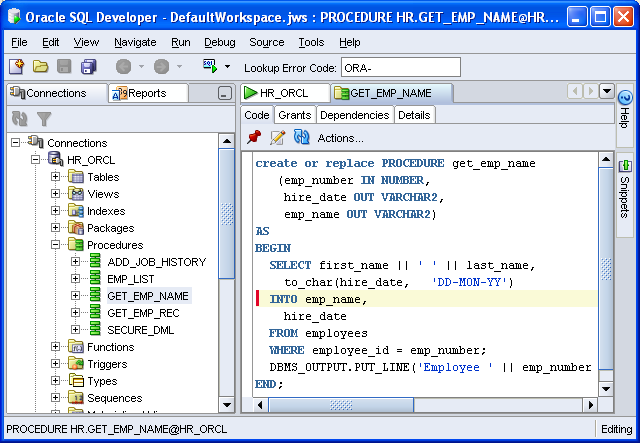
1. Let's start with a connection to the database. Create a database connection. (File -> New Connection) and complete the details. I only use the basic tab, so don't need to set up tnsnames or anything else. You'll see the database is on my own machine in this example, but it need not be.


2. Now you can connect to any objects this user owns, using SQL Developer. You can browse the various objects the user has access to. I'm only interested in this procedure, which my user HR owns.


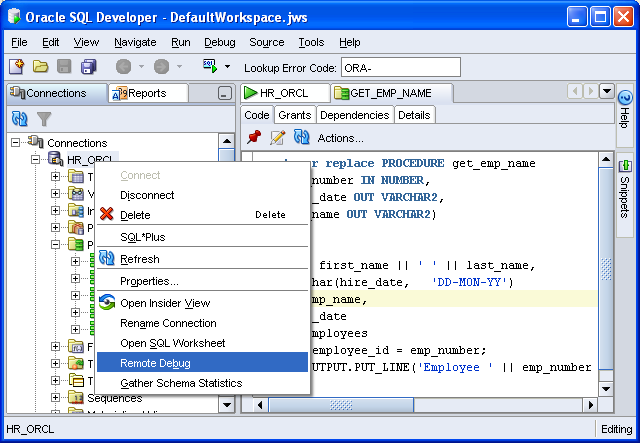
3. You can run and debug this procedure in SQL Developer, but that's not the purpose of the exercise. What we want to do is debug the procedure when it is executed from elsewhere, such as another programme or application. The starting point is to start a remote debug session in SQL Developer. You do this from the Database Connection as shown.


4. A dialog will display, requesting the listening port number and the IP address of the machine running SQL Developer - effectively it's your computer, listening for the database to connect and using that port range to do so.
You can set the range of ports through a Preference in SQL Developer. If you run into issues, look out for firewalls between the machines, blocking these ports.


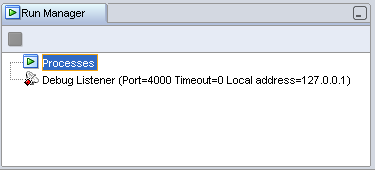
5. Once you have set the remote debug details, you should see the run manager display these.


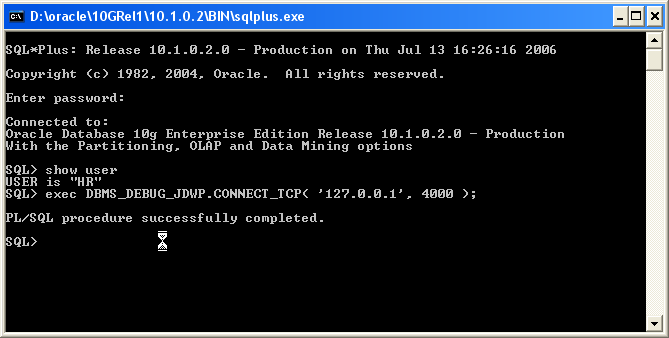
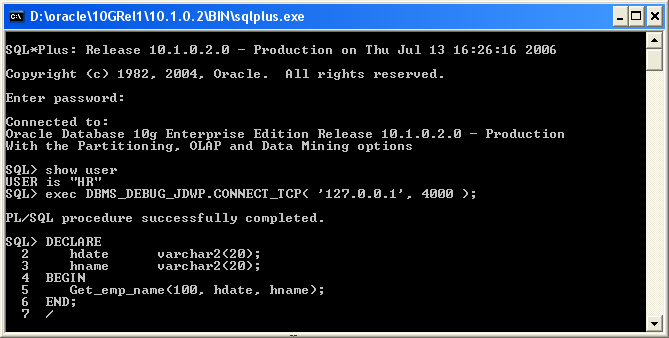
6. Now you should start a remote session. Using a SQL *Plus command line session will do.

* Invoke SQL *Plus for this user
* In the SQL *Plus session enter the following command:
exec DBMS_DEBUG_JDWP.CONNECT_TCP( '127.0.0.1', 4000 );

You should recognize the parameters from the previous dialog.

If you are debugging an application remotely, then this PL/SQL procedural call will need to go into that application, just for the debug purposes. You'll remove it afterwards.


7. Return to SQL Developer and set a breakpoint in the procedure.
Note: If you are debugging a procedure, you must remember to Compile for Debug, before you can start debugging.


8. Now you need to return to the SQL*Plus session and execute your procedure. If you debug in SQL Developer, an anonymous block is created for you to execute the procedure. In this case you'll need to write one to execute the procedure from SQL*Plus.

Note: In the procedure we have a DBMS_OUTPUT command, so you should also add the 'Set Serveroutput on' command.


9. As soon as you execute the anonymous block, you'll be returned to SQL Developer to debug the session there. Step into the code as you would in a usual debug session.


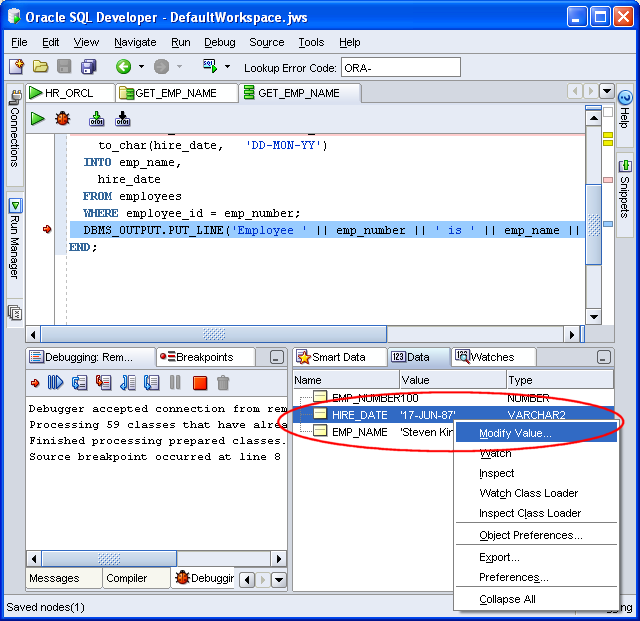
10. You can watch data and modify values in the same way as a normal debug session.


In this example, I'll modify the hire date.


11. Once you have reviewed the data, or made the modifications you want, resume debugging. Once the debug session is complete the control is returned to your remote session. In this case, SQL*Plus. You'll notice the modified date reflected in the output.


Quite a long piece, I know, but I think we often veer away from the unknown or untried. Hopefully once you have walked through an example, you might be able to make more use of this very useful feature.

28 June 2006

ODTUG's new Website

Following my last post, Kent has now posted a comment on how you can find his presentation on the new ODTUG site. You can download his talk on the site here:

If you look at the URL...http://www.odtug.com/pls/htmldb/f?p=500:...
you'll note the htmldb format. This is because the site has been redeveloped using Application Express (htmldb). It's worth noting this on 2 fronts. One is that many folk think that an Apex (affectionate abbreviation for Application Express) is not capable of producing complex or interesting sites and the other is that the redesign makes getting to articles much easier.
You'll see that some articles are for members only (Kent's is public). Not sure what drives the decision as to which articles are public and which are for members only, so you'll need to watch for that. There are certainly a good number of public articles and presentations available on the site.

19 June 2006

ODTUG and Quality Data Models through Humiliation?!

This week I'm in Washington DC at the ODTUG annual conference. For those of you who don't know, this is a well established Oracle Developer's User Group, originally focused primarily on Oracle Designer (then CASE) with a close second in Oracle Forms.
Today's keynotes saw two old familiar faces;
Marco Tilli and Sohaib Abassi, both long time friends of the conference and in their time, were Volley Ball players on whichever beach or piece of sand wherever that year's ODTUG conference was being held. Back, this time not talking about Forms, Portal or Designer, but how we should all by now be more aware of SOA, of how business services can be reused, of integration and of the whole importance of data integration and its importance in the industry today.
With Java and the whole J2EE explosion, ODTUG have had to reinvent themselves. Something I was not sure they'd do with success, but I think they have cracked it. The halls are buzzing with old familiar faces. Some developers are not currently working with Oracle technology, yet still they return, the contacts and friends made at this event too important to lose. Other developers are reinventing themselves, learning new technology and bringing wisdom and experience to the table. This year, not too many grumpy old men!

Interesting too was the large number of first timers at the conference this year. I'm always amazed at this, the number of newbies arriving at the various conferences I attend. It's always a healthy percentage.

This year's ODTUG conference offers half day hands-on sessions alongside regular presentations. The weekend prior to the event, they ran a full day Web Architecture Symposium, which I have only heard highest praise for, and a couple of full day hands on sessions. I'd say attendees can get their monies worth if they participate in all on offer, specially if they get involved and mingle and talk, listen and learn!

Peer Reviews
The first talk I attended was Kent Graziano's talk, "Data Design Reviews: Using Extreme Humiliation to Ensure Quality Data Models". What a title!
Using the peer reviews they use within his department as a basis for his talk, he told us about building effective data models. They have a fixed set of standards, build logical models, which must conform to those standards, and have rigorous peer reviews. Once accepted, these logical models are then transformed to physical models, which have to conform to standards, and then have rigorous reviews of these. If and when these all pass and are accepted, the DDL is generated and reviewed before being passed on to the department that consumes them. They do not spend months on building models before reviews, but have incremental builds, so the review is brief, less than an hour, and they have them often.
I think the rigorous could be scary, specially for new folk, but the peer to peer knowledge transfer and the team work must outweigh any disadvantages. I loved the sound of the approach. (Specially having seen a few sick models in my time) I also think this practice can and should be translated to any part of a company - from those writing coding, to those writing papers and producing power point presentations. You might think this would slow down the pace, but I suspect teams would be more efficient, and the resulting work of a much higher quality.
Aah, by the way, Kent stressed, "it's business, it's not personal" For example in a peer review, when you criticize the name of entity, it's not because you don't like it, it's because it doesn't comply to the standard. I think so often we are too defensive, we assume someone is critiquing us, our approach, but if you have a set of standards, then things are less subjective and in the end, better for the good of the project and in the end, the company.
If you can, take a look at Kent's paper on the ODTUG site. It should be up after the conference. Kent is also author of a few books on data models, if you are on the lookout for one.

07 June 2006

Storing Images in the Database, the Scottish User Group and Mod PL/SQL

Yesterday I had an earlier than usual start. I was off to Scotland for the Scottish User Group SIG and had planned to fly up and back in the day. This is easy. The early bit is because I have a mutt (said mutt) and I take him for a walk every day, rain or snow. I am also pretty determined not to short change him, so yesterday we did our regular 50 mins starting at 5am. Now I realise for many of you that this is not a big deal, but it's earlier than my regular start. It was incredibly beautiful out and I'd recommend it to you all. But I digress - the Scottish OUG...

This was my first venture up to North for a SIG, and I was very impressed. They ran two streams, BI and Development, and had a nice attendance. The only snag was the very fine weather. When it's that good, the attendance can peter off as the day progresses. If you live in one of those places in the world where every day provides clear blue skies, you might have no understanding of this. But if you come from a spot where recognising the sun is not always easy, then you'll know what I mean!

I was impressed by the both the variety of talks, the variety of topics covered and that they weren't all Oracle presenters. More recently, Oracle speakers have dominated the SIGs I have attended. As these are Oracle USER Groups, I find it refreshing to hear user experiences and input. When I pointed this out to Thomas Presslie, one of the SIG chairs, he said it was actually unusual to have as many as 2 Oracle presenters at one event, as he avoids this as a rule. Grant Ronald spoke about JDeveloper and ADF and I did a SQL Developer

One of the more refreshing talks I'd been to in a while was by Marcel Kratochvil, from Australia. He is in Scotland doing some work locally and Thomas persuaded him to come along. He works for Piction in Australia. Marcel doesn't have a blog, but there is this article on OTN about storing images on the database. Their area is multimedia and they help companies with content and managing their digital resources. They use Oracle, mod_pl/sql and hence PL/SQL, because it's fast, scalable (up and down...) and he can use the power of the Oracle database. He threw a lot of curve balls into the group, asking questions that maybe people have stopped thinking about. I can't write out his whole talk, but like Tom Kyte, he seems to have a "question everything" philosophy. I like that. We can slip into taking things at face value too quickly. I am not suggesting cynical, I suggesting thinking about what's been proposed, before just accepting, regardless of the 'authority' proposing it.

I was also impressed with the piece of news that they use mod_pl/sql and he repeated, "PL/SQL is FAST" (read with Aussie accent) a number of times. I used to love that technology when I worked with it. One of the first courses I wrote many years back, after "Oracle Designer New Features", was the Web Server Generator course (or WSG as it is/was affectionately called). We generated PL/SQL, used owa and htp etc and of course mod_pl/sql. Very performant. Of course this is the architecture for Application Express (HTMLDB) and you may know that many Oracle sites (See Apex Studio and Apex References), are built using this technology. I know, from past experience that many, many companies out there have used this technology, very successfully. Many are hand coded, i.e. not using Application Express or Generating from Designer. It was refreshing to see there are still folk out there, very happy with this technology.

It was quite fitting then this morning to see Pete Finnigan's blog picking up on Laurent's article on mod_pl/sql. While Laurent talks of how easy it is to get started, Pete is a security man, so you should think about them both. This had me do a little search and Roland Bouman does a piece on setting yourself up on XE. So now you have enough links to get lost in the web for at least a morning!

Of course, sitting behind all of this PL/SQL stuff, is the need for a nice little tool to help you edit and debug and review... so do download SQL Developer and give it a go. When I talk about SQL Developer, I end up demonstrating a lot of the functionality and as with any product, there are things I do, that others are not aware of. So not only did that part of the audience who've not yet ventured into using the product say they would be downloading it now, but those who are using it found a few more features.

Go on - give it a go -

I'd like to hear from you.

30 May 2006

Write Your Own Extension to SQL Developer

SQL Developer is not yet 6 months old, whether you are talking first appearance on OTN in the Early Adopter in late December 2005, or initial production release in March 2006. Already there are four extensions available on external sites. Take a look at the new Extensions Exchange for SQL Developer on OTN and see if there is something there that interests you.

Why not write one of your own? You might have a utility that you use all the time or some functionality that would make your daily tasks easier.

Kris Rice has a few entries on his blog on writing extensions, so take a look there and see if there is something that might trigger an idea or offer some advice. Of course you can also take a look at the extensions written by the JDeveloper team and user-base, as their exchange has been running for a few releases now.

Here are the links to Kris's extension entries:
Have fun.

...and let me know if there is anything you've written that we can add to the site.


25 May 2006

SQL Developer is Free, so how is it supported?

Following my last post I was asked a very important question. "...care to comment about the support process for SQL Developer?"

Yes, absolutely, I'll comment. Firstly though, I'm going to point you the Pricing FAQ. Ahem..., how is it we have a Pricing FAQ if the product is FREE? It's because we have so many questions on what FREE really means that we put a small note onto OTN.

FREE means it's free to download and use. We have every intention of keeping things that way. On that point, just the other day someone said, while it's free, no-one will take us seriously... That's another can of worms I'm not going into just yet.
When it comes to support, many users are using the forum to ask questions and post comments, which is fine. Actually it's great. The snag with a forum is that, as the poster, you have no guarantee your questions will be answered in a timely fashion. The wonderful thing about the forum is that not only are the Oracle SQL Developers responding, more and more of the user community are also responding. This is good, because it means the developers can get on with adding functionality to the product!
But, as the comment states, if you log an issue on the forum, be it a bug, enhancement or feature request, how can you be sure it's tracked? You can't. We have many posts to the forum each day and we're tracking as many as we can.
You might be interested to know that a group of forums have an application as a front end to list those questions that have remained unanswered. Due to the huge volume of posts on our SQL Developer forum, we have joined this group to ensure, where possible, all questions and comments are attended to either by us or the community. Where there are issues or requests, we add them to our bug and task lists. So we are pretty confident that we have a good grasp of the feature requests and issues.

Another route is Oracle Support. In this instance, even though the product is FREE, you ARE supported through Oracle Support if you have a valid Database support license. So you can create a ticket (iTAR, or online Service Request...Technical Assistance Request (TAR) via MetaLink. ;-) ) and the issue is tracked. Members of the development team work with Support on these tickets too.

I must mention that Oracle Express Edition (XE) is only supported through its forum. So if you are using XE and SQL Developer, Oracle Support will direct you back to the SQL Developer forum for your questions.

I hope that helps!

17 May 2006

Just What is SQL Developer?

I've noticed this over the years, that as people become more and more familiar with a topic or subject area, they assume the rest of the world is right there with them and rattle on in terminology and concepts that would boggle most brains. I think you can take most subjects and you'll find this to be so, it's not just an IT thing...

I remember sitting at a brown bag lunch at a user conference a few years back. The point of the gathering was that anyone with questions could come along and ask questions and other with experience in the product would help and answer. The intentions were well meaning, the idea being to grow a community of sharing experience. As I sat in the back listening, I realised the experts were so far advanced and so skilled in the subject area, that they couldn't (or didn't) answer the basic questions. They were so used to dipping into the API and their own additional code, they'd got beyond the basic product! They were so used to responding to deep technical problems, that they didn't really hear the question. The answer to "Mum, where do I come from?" might just be "Cape Town" !

I fall into the same trap too. When asked to write an article for a magazine recently, I said "What would I write about?" The response was that we need articles for entry level. I accept it's true we need to have advanced material and more technical articles both at conferences and in our journals, but we should not forget that there are so many levels in our knowledge and expertise. More often than not, when submitting a collection of abstracts to a conference, it's my introductory talks that are accepted from the selection.

I've only been involved with Oracle SQL Developer for a few months now and already I assume that everyone who uses an Oracle Database should have heard about it. But why should they? There is so much news and information coming from Oracle and other companies all the time, that we're all getting quite good at filtering spam. (Basically, just deleting messages which appear to be spam). I should also remember that even after 2 years of presenting on the Database support Oracle JDeveloper offers, I was still encountering significant percentages of folk in the audience who had no idea JDeveloper had this capability. So this kind of news takes time to filter into the general community. As with other information, it's only useful or relevant when you need it!

We've just added a brief "What is SQL Developer" article onto our site on OTN. If you've not heard of the tool, or are afraid to ask, because, like me, you might assume the rest of the world already knows, then check it out.

Of course if you know about SQL Developer, it doesn't harm to take a look and see if it does something you weren't aware of!

By the way, we released a patch to our production release, Oracle SQL Developer 1.0, so you can Check For Updates. If you are going to be using the check for updates capabilities, then do be sure you are on the production release. (See the FAQ if you're uncertain)

03 April 2006

Gathering Stats

Do you sometimes sigh when a speaker starts off by gathering a few bits of information about the audience. "What release of Software X are you using?" This can be tedious when you are at a conference and you go from room to room, being repeatedly asked the same question. Instead, do you think, "Hey, the speaker is going to re-focus the talk, to address our needs, for a change!", when you all put your hands up to acknowledge experience in a specific area, and so might be spared the tedium of having the same old stuff explained again.

While we, as speakers, can't always rewrite a talk in midstream, we can avoid mentioning bits of irrelevant material. In the same way, if there are features no-one uses or needs in a product, maybe we should be focussing our development energies elsewhere. So stats can be useful.
You know this. They can help people make decisions and they can be used to great advantage. Obviously they can be skewed, they can be harmful and used for the wrong reasons, and they can be used to misrepresent the true picture etc. etc. Let's not go there.

Well, we're after a few stats on our SQL Developer Forum. As you know it's pretty early days for SQL Developer and we're trying to establish the demographics of our audience. We want to use them for your advantage! So, if you use SQL Developer and you visit the forum, please take a look a the Forum Polls. We're hoping to update them every few weeks. What we'll be doing is running quick polls to pick up a few bits of useful detail.

Now our stats our a little skewed at the moment. With are only a few folk clicking at the polls, compared to the 1000's of downloads and visitors to the forum, the results aren't all that accurate. Once you've signed on to the forum, it's just a click. Help us ensure we get an accurate picture.


31 March 2006

Mind Maps, Migration and Meetings...

I did a quick road trip this week. Just a hop across the Irish Sea to Dublin to meet one of the development teams there. What fun. It's been a while since I spent time with a development team brain storming and planning. I hope you understand "lost in the moment". For me it happens with things like photography, gardening and writing and sometimes work. It's when time becomes elastic and you get lost in it. (I tend to skip meals and don't sleep.) I'm not advocating this for every day, it's detrimental to life in general. Now we didn't do that in Ireland this week, but we didn't spend time clock watching either. We spent two full days sharing ideas, I learned about their product and talked about the product, its directions and future. It was great. [ I've talked about learning being good for the soul before]

Now you can have meetings that are good, but once you walk away from them, that's it. No actions, no plans, no ownership and that's worse than not having a meeting at all!

The product team I met with are the Migration Technology Group and they are building the Migration Workbench as an extension to SQL Developer.

You'll hear more about that team and the technology over the next few months. In short, the current Oracle Migration Workbench technology helps users migrate to Oracle from databases provided by companies like Microsoft, Sybase, and Informix. The Migration Technology Center on OTN offers information on the existing product.

Back to Meetings

Don't you just love 'em? hmmm. I've worked in teams where I think some folk rate their importance factor by how many meetings they attend. So for meetings do you picture some attendees arriving late and dashing off early, meetings running over, there is no agenda, there are no actions and the result? Well, there
are no results!
Good meetings are fab, specially if you are a distributed team. They can be stimulating and productive. I think a good meeting has an agenda, a good leader (who ensure everyone is involved and no-one dominates) and ends with a set of actions (with owners). Minutes are useful too. It means we all know the actions and have a note of what was said and decided, so that we don't have to have THAT meeting content again. (To redecide an action previously decided). I'm not a stickler for minutes, but a list of actions and owners is a good thing.

Take the meetings in Dublin this week, I used a mapping tool to note the discussions. They're my notes and are not verbose, but they're not on bits of paper, instead I have them in a mind mapping tool. The great thing is, I can share the results with the team at a click.

Let me go back a pace. Just before I joined the SQL Developer team, I started drawing 'mind maps' - you might also think of them as spider diagrams. Basically, just listing the variety of tasks I might get involved in if and when I joined the team. Conferences, customers, writing collateral, bug reviews, forums, web sites etc. Each time I thought of something new I'd add it. A friend told me about Mindjet's MindManager and so tried their 30 day trial version. When my manager saw how useful this was to me, he said "order it". There are mapping tools in the open source world too, so take a look at what's available, if you're not able to purchase this. (They don't have a Mac copy just yet - you gotta go open source for that)

I've written a white paper, a few magazine articles (to come out in the next few months), "Getting Started with SQL Developer" and some presentations and I used Mind Manager for all of these. You start with a spider diagram of ideas, flesh them out and 'generate' a power point presentation, word doc, html or even Microsoft Project. Then you have a great starting point. Doing the articles this way helped me with the flow. I am not managing any multi- people projects, but I've heard it works a treat for tasks and dependencies in Project. How often do you go back to your notes and look for something ( or never go back...worse) With software to help, you can search. With this tool, I can search across maps (meetings). I can also hook into google searches and news feeds!

So back to my meetings this week. All my notes ended up as maps, and at the end of it all, I added a power point template and created a presentation for the team, to keep as a record of the meetings and the decisions.

I did not write this blog using Mind Manager, so if it's rambly and all over the place. That would explain it.

hey - take a look at OTN - of you've never used SQL Developer, perhaps you don't have access to your own database, then try Oracle Express Edition (FREE) and check out SQL Developer. There's a Getting Started with SQL Developer guide.

17 March 2006

Agile again...?

On Tuesday I went to the combined UK SIG. If you read Andrew Clark's blog and then link through from his to Rob Baillie's blog, you might might be forgiven for thinking that only the three of us attended this SIG and agreed to all write about each other! Not so.

I go to these events pretty regularly in the UK, as I was "buddy" for the Modeling and Design SIG until the end of last year. These special interest groups focus on specific aspects of anything Oracle related and, as such, the UKOUG support a huge number. On Tuesday we had the second running of a combination of Tools, Modeling and Design and the Apps Server SIGs. This mix is quite fun, as I get to see a few talks in disciplines I typically don't get to see. I enjoy these events, because I get to talk to people who really use software and who praise and remonstrate in equal quantities. Feedback is key.

The highlight of my day was attending an Agile Programming talk. I was going to tell you at length about it, found and read Andrew's blog and to my delight, found the link to Rob's site and a write up of his talk. Do read it.

Briefly his talk was about Agile programming. Now the OO world and many Java developers love this, but the old timers (if you're about to stop reading, you might be one of them...) really don't go for this 'extreme programming...' I've heard the words 'cowboys' and programming thrown into the same sentences and sentiment. So here's the deal. Prove to me this works.. then tell me how you did it. Give me the facts... not the fantasy. ...and that's what he did.

Rob stood up and told us about his last 18 months and the very successful project they have been working on. His introduction was quite long, and went into detail about the project and his experiences. I got this from it. In 18 months, they never had a release fail. Think about that for a mo...

They had a demo environment and released regularly into this demo environment. If a user wanted a feature, this would be coded and released within days to that demo area. So the user had a response, and a tangible one at that. They also released into their production environment often. Did I mention they never had a release fail?

Surely these are proof points of a successful process.

He didn't mention what tools or products they used, or speak about the app itself. He didn't introduce the talk by explaining agile, or talk about the founder members ...blah blah... He didn't talk about the various points you have to do to be considered an agile project. He had 5 slides. Each slide had a sentence on it. Here are the points as I recall them:

  • Understand version control
  • The repository is truth
  • An idiot must be able to run the upgrade (build) scripts
  • Every developer gets a sand box
  • Every sand box has a database

Understand version control: Basically, you don't need a tool, you need a process. It's made easier with a good tool, but without a process even the best tool is hopeless. Your developers and team must trust and use both the tool and process. One without the other is not enough.

The repository is truth: Well, any Oracle Designer user would agree with that. He didn't say that or even talk about what a repository might be, whether a database or file system. Basically his point here was: Can you rebuild your system from scratch if the live, production system disappears NOW. Do you have all the files, all the correct, latest files available to just rebuild again? He impressed on us again, that all members of the team needs to trust the repository, as the source of truth. Even if you are not in an agile environment, I wonder just how many teams in ANY development environment can point to their single point of truth for any version of their projects.

An idiot must be able to run your upgrade scripts: This was not said in a disparaging way. Here his point was that a complex script, requiring lots of input and control, which can only be run by a select few, will probably not be run very often. This resonated with me. When something is a little flaky, I tend not touch it if at all possible. "Leave it alone, it's working..." But if you have scripts that you run daily, you'll tune them and ensure they are fail proof. The more often, more people run these scripts, the more certain you are of their reliability. So each team member runs the upgrade scripts and they upgrade their demo environment regularly. So when it comes to upgrading the production environment, they knew it would work. (and it did ...another proof point!)

Every developer gets a sand box and every sand box has a database: The sand box is "my play area" and my play area must not affect anyone else and no-one must affect me. He impressed that the sandbox must have a database. He did mention that they used schemas and private synonyms, not a database per user.

In all this was a very refreshing talk, as I mentioned, the full document is on Rob's blog.

More on SQL Developer another day. Briefly, the room was packed and there are still loads of people who had not yet tested the product. I hope they have done so by now...

13 March 2006

SQL Developer is Production

It's Monday, it's March and the new kid on the block is SQL Developer! Yup, SQL Developer 1.0 is now production. If you haven't seen this product yet, try it. Download it from Oracle Technology Network (OTN) unzip it into a directory and you're set.

The product was announced at Oracle World (OraTransplant Blog) last year, we released the first early access release on the 28th Dec 2005 and followed with a number of releases after that. If you'd like to see all the releases take a look at Eddie's blog. The key thing about all these releases is that we've been able to respond to requests and feedback from the community. I might have said this on Groundside before, it's been an exciting few months.

Part of the reason we were able to get the product out to the community so quickly is that is is built using the JDeveloper IDE. Written in Java, it installs on platforms that will run a JVM. So we offer support for Windows, the Mac OS X and Linux. Overheard in a friend's office the other day... "Hey, have you seen this new SQL tool from Oracle? It's great and it installs on Linux!" (or words similar, the sentiment is there)

As someone who was involved with Oracle Designer for many years, I know the frustration users have when they are looking for new features in a product and we either can't respond or it takes many months, if not years, to respond. SQL Developer is a much smaller product, with none of the dependencies Designer and many other Oracle products have, so the flexibility of being able to respond to needs is there. I have loved this interaction and know the team have enjoyed it too. Again referring to Designer, we started a community source project, where a team of users worked on and supplied code and input to the Designer team to add functionality to the product. It was good. It brough the community closer to the product. It's not open source, in that we still own the ocde and write the code, but these past few months before SQL Developer's 1.0 production release have been like a community project, with the community getting involved and responding in a really positive manner. Being involved means you, the users get the product youreally want.

Many folk in the community have already started reviewing and using the product, so I won't say more, let's tip-toe across a few more blogs and articles out there...

  • ITToolbox (First impressions, early Feb)
  • Amis (starting to look at extensions)
  • Andrew Clark (Starting to change his ideas on SQL Developer and happy to get things fixed quickly)
  • Dan Hotka has written a long review in the Oracle Professional newsletter
  • OTN Techblog (This one is a little closer to home)
  • Jeff Hunter (First Impressions)
  • For ongoing and regular SQL Developer updates, you do need to keep a link to Kris' blog....
This list is longer, do a few searches and you'll find them.

Aah, you'll be wanting know about support. Ask questions on the Forum, talk to mates and of course, if you have a Database Support license, you also have SQL Developer Support.

The next bit to look at is the extsnion API. There are already a few folk out there getting down to writing extensions (plugins) so now that it's production, the race is on. Let's get writing. What extension are you going to build?

02 March 2006

A New Beginning...

My current blog is down again and has been for a week. What with the spam and unreliability I decided to move. In fact my friends have been asking me to move - I think they're tired of hearing me mutter. Not that I am a regular blogger, but in this world of "instant gratification" I kinda like being able to update my site whenever I have a moment.

This is no reflection on my current Blog Host, who set me up and got me started. Like me, he is always travelling and so is equally frustrated when technology and local suppliers let him down.

Well, I've moved.

It's a regret that I may not be able to move past articles and have them archived here, but perhaps I'll find away. I'm not researching that today.

Now back to work.